Dodaj do ulubionych

"Oriented evolution towards Omeg Point" - Faixat

28.10.18, 15:58
Odzywam się dlatego, iż napisał do mnie Jose Diez Faixat. Blog poświęcony jego głównemu dziełu jest dostępny pod Tekst linka
byebyedarwin.blogspot.com/ Jego praca należy to tych opracowań, które są w stanie zburzyć samozadowolenie i spokój ducha 'mainstreamych naukowców'.

Osobiście sądzę, że warto się zastanowić nad tym co stwierdza J.D. Faixat. Nie mam czasu aby streszczać i tłumaczyć jego dzieło na język polski. Zamieszczam więc jedynie w P.S. w kilku postach początek zapisu jego teorii.

No cóż albo hipoteza Faixata kogoś zaintryguje albo nie. Sądzę, że istotną umiejętnością jest dostrzeganie wywodów ważnych, nawet jeśli kłócą się one z tym co się nam podoba... do czego jesteśmy przyzwyczajeni. Pozdrawiam ~ Andrew Wader

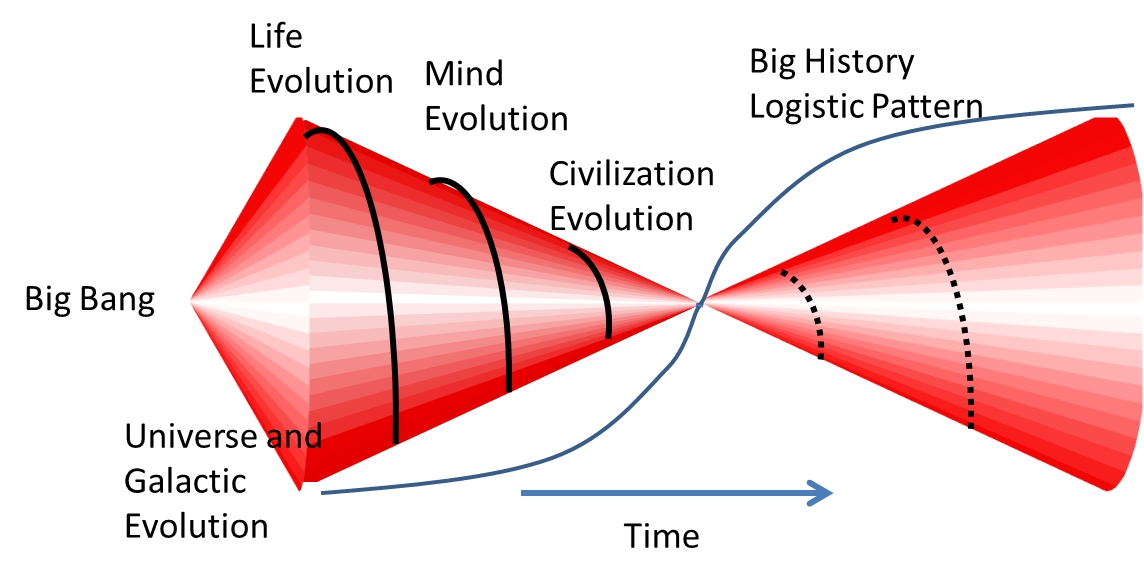
Rysunek Jose Diez Faixat'a
https://4.bp.blogspot.com/-4HOvaLWZEyw/WrA45vHQGKI/AAAAAAAAAPQ/M1q_zRAAJdUebeoCQL7ppekwwoTkkhD7ACLcBGAs/s1600/david%2Blepoire.jpg

P. S.
THE HIDDEN RHYTHM OF EVOLUTION BY JOSÉ DÍEZ FAIXAT

TO
SRI AUROBINDO
PIERRE TEILHARD DE CHARDIN
ERVIN LASZLO
KEN WILBER

Abstract

This article surprisingly reveals the existence of a very precise spiral rhythm in the emergence of the evolutionary leaps that mark the history of the universe.

The proposed hypothesis is very simple: just as in any musical instrument successive second harmonics (1/3 of the vibrating unit) progressively generate new sounds; these same second harmonics generate all the major evolutionary novelties in universal dynamics as a whole. It is truly surprising that such a simple proposal is found to be precise and categorical when cross-checked against historical data. Let us see.

Fitting our ‘periodic table’ of rhythms to the date of the appearance of matter –the Big Bang– and of organic life, we see that every single instant of the emergence of successive taxonomic degrees of human phylogeny is marked out with utter precision: Kingdom: animal, Phylum: chordata, Class: mammal, Order: primate, Superfamily: hominoid, Family: hominid and Genus: homo! The same then occurs with all the stages of maturation of our primitive ancestors: H. habilis, H. erectus, archaic H. sapiens, H. sapiens and H. sapiens sapiens! Once more, the precision of our hypothesis is repeated in the successive transformations that humanity has experienced in its more recent history: the Neolithic, Antiquity, the Middle Ages, the Modern Age and the emergent Postmodern Age! If, as we see it, all these stages resoundingly fit the provisions of the ‘periodic table’ of rhythms that we have proposed, it is more than likely that our hypothesis may also provide the key to glimpse the successive phases yet to be deployed in the years to come in an ever-accelerating process that will eventually lead to a moment of infinite creativity –Omega– within a couple of centuries.

All this is, indeed, unexpected and surprising, but is now almost certain when we verify that the same hypothesis that has behaved with utter precision when applied to the process of global evolution, also does so when cross-checked against the process of development of the individual human being! Within the same time frame, with the same pattern of folding and unfolding, and passing through the same stages, our ‘periodic table’ of rhythms periodically marks out –step by step– the successive phases embryologists, developmental psychologists and spiritual teachers talk of, thus confirming the old idea of phylogenetic-ontogenetic parallelism and pointing very specifically to an astonishing fractal and holographic universe.

It is impossible, absolutely impossible, that all this accumulation of linked “coincidences” –in both the field of overall development and that of individual human development– highlighted in this paper is the product of mere chance. The conclusions that emerge from all this clash head on with many assumptions of predominant materialistic science. Our proposal, which provides a better fit to the presented data, points to the non-duality of energy and consciousness, as posed by many traditions of wisdom. From these pages, we invite all our readers to participate in this emerging experiential and theoretical research in which dazzling prospects can be glimpsed.

CDN
Obserwuj wątek
    • andrew.wader Re: "Oriented evolution towards Omeg Point" - Fai 28.10.18, 16:01
      CD
      Jak postulowałem, sądzę, że warto się zastanowić nad tym co stwierdza J.D. Faixat. Nie mam czasu aby streszczać i tłumaczyć jego dzieło na język polski. Zamieszczam więc jedynie ciąg dalszy początku zapisu jego teorii.
      .............................................................
      Odcinek 2
      ............................................................
      Introduction

      Hi everyone!

      For many years, I have been intrigued by the fascinating creativity of the universe, in its material, biological and mental aspects. More than forty years ago, I tried to find an answer to the surprising evolutionary phenomenon, passionately investigating within the diverse branches of Western science and simultaneously in the rich existential research of the Eastern traditions of wisdom. Suddenly, unexpectedly, all that research crystallized in January 1981 in a very precise hypothesis about the rate of the evolution.

      On collating this hypothesis –which in principle seemed to be a simple, ingenious and daring insight that had fall out of the blue– with empirical data from different spheres of reality (paleontological, anthropological, historical, embryological, psychological, etc.) and verifying its surprising validity and precision, over the years it has been become a solid scientific (falsifiable) proposal that shows an unexpected periodic pattern in the emergence of evolutionary novelties and that hence clashes head-on with the still prevailing view of how the world works.

      As this paper has been written single-handedly during this time, with no other company than hundreds of books, and given the breadth and scope of the proposal, it seems advisable to open this hypothesis regarding “the hidden rate of evolution” to public criticism so that those interested can carry out their own inquiries with a view to testing its validity and, if need be, make any adjustments they deem necessary. You are cordially invited to do so!”

      To start off, to set the scene, I will outline the general scenario within which we will develop our proposal. Things are changing.


      A new universe

      During recent decades, the apparently solid view of the mechanistic and materialistic world has started to show alarming cracks. Approaches that a century ago were taken as rigorous and almost irrefutable are starting to be seriously questioned.

      These approaches postulated that the universe is moved by a simple game of chance, in progressive degradation and inexorably tending toward thermal death. In major contrast with these dark auguries, new science views –beset with surprise– a fascinating creativity in all spheres of reality. An unstoppable evolutionary current runs through entire history of the cosmos, one that generates all types of novelties. The supposed universal machine, virtually condemned to the scrapyard, is now revealed as a rare living being animated by a self-creative permanent force. It seems that Nature starts to reveal the secrets of its holistic inner tendency, one which drives it to climb the ladder of organized complexity. This ascending drive has been creating progressively differentiated, integrated and inclusive units step by step.

      Mechanistic Science harbored the reductionist dream of explaining the functioning of complex structures starting out, exclusively, from its most basic components. New science has forsaken that dream on verifying repeatedly and in diverse levels of reality that the whole is greater than the sum of the parts. The flow of evolution engenders novelties which, though logically compatible with precedent structures, cannot however be explained by them. There is thus a dynamic, hierarchical schema of the world in which emerging levels are integrated with previous ones, thereby generating more complex, inclusive organisms with increasing awareness. Elemental particles form part of atoms, atoms part of molecules, molecules part of cells, cells part of organisms and so on. The universe thus reveals itself as a hierarchy that extends unlimitedly upward and downwards throughout the course of evolution.

      On the other hand, each one of these levels of universal reality is structured by an infinite reciprocal interplay among individuals and communities. Some and many are involved like reflections in a grid of mirrors facing one another. An individual devoid of an environment is not possible, neither is a group without the individuals that compose it. We cannot separate off isolated unities in these universal networks of interrelationships and interconnections. As Quantum Physics has demonstrated, the scope of these complex webs of relations goes beyond what is humanly conceivable, even transcending our time and space schemata. There are no actually separated “parts” in any level of the evolutionary scale. On the contrary, as in a holographic plate, each “fragment” of the world is no more than a concrete expression of the same, unique totality. The universe starts to reveal itself to the eyes of new science as a unified field that is dynamically reflected in each and every corner of itself.

      Attempts were made to build the world upon the solid and strong foundations of matter, but this myth has not stood up to empirical testing. Subatomic analysis has literally taken the floor away from under our feet. Our supposedly indestructible material basis has dissolved in pure forms, patterns, orders and relationships in a fabric that is no longer substantial, but purely abstract instead. We are supported by evanescent forms that vertiginously emerge and disappear in an intangible void. Within the scientific community, it has even been asserted that the universe is beginning to look more like a great thought than a great machine.

      The materialistic focus of classical science also aimed to describe the world “objectively”, placing the “subject” making the description on the sidelines. However, the emergent postmodern perspective has once more revealed the complete ingenuity of this project. The observing mind is inevitably part of the observed universe. There is not object without subject, no outside without inside, no reality without consciousness. Both terms are definitively interrelated and therefore any attempt to comprehend the phenomenal world integrally must necessarily include both facets. The dynamics of evolution is thus perceived as a generator of entities, not only progressively more organized and complex in their external appearance, but also, at the same time, of greater inner awareness. We cannot limit our vision solely to the surface of things, because, although we try to ignore them, the depths of lucidity will finally become patent to us over and over again.

      The universe that surprisingly begins to reveal itself before our gaze has little to do with that blind, insensitive artifact, that mechanical and inert world in which the human being imagining it, did not even have a place in it. The new approaches that study reality no longer consider us aberrant creatures in a world without sense, but rather as redolent expressions of the creative flow of totality, authentic microcosms that reflect with increasing clarity, the infinite richness of a fascinating macrocosm.

      Our research on the rhythm of evolution falls within this new perspective of a universe that is self-creating—a generator of progressively more complex and organized novelties,—, hierarchical —in which each new level transcends and becomes integrated with all previous levels—, holographic —in which each part reflects the totality—, impermanent —in a continuous dance of creation and destruction—, lucid —capable of knowing itself—, and void —without a basic substance that supports it.

      In this new emerging outlook, our daring proposal that a harmonious pattern that governs the rhythm of evolution exists no longer sounds so shocking. Let us see.

      CDN
      • andrew.wader Re:"The crisis of Darwinism" - Faixat 28.10.18, 16:04
        CD
        Jak wspomniałem, sądzę, że warto się zastanowić nad tym co stwierdza J.D. Faixat. Nie mam czasu aby streszczać i tłumaczyć jego dzieło na język polski. Zamieszczam więc jedynie ciąg dalszy początku zapisu jego teorii.
        .............................................................
        Odcinek 3
        ............................................................
        The crisis of Darwinism

        Nowadays science agrees that evolution is a core feature of the universe. There is a complete consensus regarding the dynamic and creative features of phenomenal reality in all fields of human knowledge —astrophysics, biology, psychology, sociology, and others—. Nevertheless, there are discrepancies in the interpretation of the facts.

        Darwin’s theory of evolution was primarily based on random mutations and the “survival of the fittest”. The “synthetic theory” extended these formulations in the late 1930s and early 40s with the contributions of Mendelian genetics and population-based genetics, maintaining as explanatory basic elements the aforementioned random mutation and natural selection. This synthetic theory enjoyed almost unanimous acceptance for two or three decades, but gave rise to a great wave of dissent from 1970 on. The idea that the synthetic theory is wrong is beginning to take shape for many paleontologists, geneticists, embryologists and taxonomists, who refute the random factor as the sole principle governing the evolutionary process. They disagree that natural selection explains the emergence of new species. They affirm that fossil records do not fit Darwinian gradualism and denounce that the theory does not reflect the phenomenon of increasing complexity.

        Biologists find it very difficult to understand how a fundamentally random search among an extremely high number of possibilities could result in the emergence of living beings with their evident level of complexity. As we understand it today, evolution cannot be conceived as having random variations as its sole material. Organisms vary as a whole; huge numbers of mutations would hence be required to occur simultaneously, in the appropriate way, when their “need” arose and with a close links among them… How could all this be fulfilled by chance? The same could be said of the formation of any of the complex organs, for example, the internal ear or the brain. A classic problem has been the difficulty in explaining intermediate forms in the development of complex adaptations, as in the case of the eyes. Darwin himself confessed that it was absurd to imagine that the eye could have evolved by natural selection.

        Darwin’s original idea about new species emerging gradually at the initiative of natural selection along the course of time is currently being questioned. The simple principle of natural selection seems inadequate to understand and predict all evolutionary processes. Spontaneous mutations may explain variations within a certain species, but not the subsequent variations among them.

        Long before Mendel’s laws were known, many varieties of plants and breeds of domestic animals were already being developed by means of selective breeding. There is no reason to doubt that a similar development of breeds and varieties may arise in Nature under the influence of natural selection instead of artificial selection. The mechanisms of microevolution —small evolutionary changes consisting in minor disturbances in genetic proportions, the number of chromosomes or chromosomal abnormalities— may be explained by the Neodarwinian theory as a function of random mutations , Mendelian genetics and natural selection. However, this mechanistic scheme, which may be valid at a small scale —in a given species—, encounters countless problems when trying to explain the origin of new species —known as “speciation”— and even greater difficulties when faced with the emergence of genus, families or higher taxonomic divisions. Macroevolution or typogenesis —the evolution of these higher-order taxonomic categories— show far too pronounced differences among divisions to have arisen from gradual transformations. The conclusion seems to be that the laws that govern large-scale processes —such as the origin of new types or the extinction of species— are different to those ruling the simple processes of adaptation to the environmental. Thus, the reductionist expectations of “macro” scale processes being immediately inferable from the “micro” scale are fully refuted. In the words of C.H. Waddington: “one of the most fundamental problems of the Theory of Evolution is that of understanding how the evident discontinuities found among the main taxonomic ranks: phylum, family, species, et cetera, have emerged”.

        The growing sensation prevails that is no longer possible to explain speciation simply by natural selection. Some have even asserted that natural selection does not in fact have anything to do with the emergence of new species. In recent years, the gradualist conception of evolution has been seen to be responsible for only a small part of evolutionary change. Furthermore, deepest changes in the biological evolution have been seen to take place in specific moments of the history of groups, occurring in a very rapid manner and giving rise to stable species that suffer very few subsequent variations.

        Fossil records mainly consist in thick layers of earth in which some species are evenly distributed, separated by thin surfaces through which species suddenly change in a process of multiple speciation. Many paleontologists think that this intermittent history shown by fossils should not be attributed to simple gaps in the record, but that it basically demonstrates the rhythm with which life has evolved. Therefore, many of them have started to dispute the classical conception of the tempo of evolution. The Darwinian version of a slow, continuous and gradual process has given way to the interpretation characterized by discontinuous, sudden leaps and changes. There is hence an evident renaissance of the idea of vigorous, sudden and energetic speciation, versus calm gradation, strongly giving rise to the perception that fossil records contain much more information than what might be imagined via natural selection alone. This is due to the emergence of non-predictable patterns thanks to our present knowledge about small-scale populations and processes.

        In 1972, S. J. Gould and N. Eldredge published a seminal paper in which they demonstrated that nature progresses by sudden leaps and profound transformations and not through small adaptations. According to the theory of punctuated equilibria, evolutionary leaps are relatively sudden processes; speciation stops for long periods in which existing species persist without fundamental variations and without creating new species (stasis). While a species persists, it remains relatively invariable; its legacy of genetic information is transmitted without major changes to the following generations. At some point, however, this stasis is suddenly broken and an evolutionary leap forward takes place. As Gould puts it, “the history of any one part of the earth, like the life of a soldier, consists of long periods of boredom and short periods of terror”.
        However, synthetic theory has difficulties in explaining not only the sudden changes in species, but also the long periods of stasis. Therefore, some researchers have begun to seek possible explanations for the sudden emergences of new species —analyzing changes in the rhythm of embryonic processes that may produce major effects in adult organisms— as well as the surprising stages of stasis —studying the possibility that the genetic or biological development of organisms may permit no more than the monitoring of certain morphological routes. In that case, once the species .... CDN
        • andrew.wader Re:"Oriented evolution" - Faixat 28.10.18, 16:11
          W niniejszym, ostatnim poście, dotyczącym teorii Faixat'a jest zamieszczone zakończenie rozdziału o kryzysie teorii Darwinistycznej oraz rozdział o tak zwanej "ewolucji ukierunkowanej".
          ........................................................

          However, synthetic theory has difficulties in explaining not only the sudden changes in species, but also the long periods of stasis. Therefore, some researchers have begun to seek possible explanations for the sudden emergences of new species —analyzing changes in the rhythm of embryonic processes that may produce major effects in adult organisms— as well as the surprising stages of stasis —studying the possibility that the genetic or biological development of organisms may permit no more than the monitoring of certain morphological routes. In that case, once the species has found a good solution to environmental problems, it will adhere to it by means of numerous changes and secondary genetic disturbances, not changing again until it has achieved a suitable stable solution for the future.

          Specialists in macroevolution make other provocative observations about fossil records that are difficult to explain from simple Neodarwinian postulates. For example, the fact that the simpler an organism is, the longer its period of permanence period, or the fact that complete diversity seems to be closer to a stationary state (or stasis), i.e. the tree of life has stopped sprouting branches and has reached a certain equilibrium, or the ever present puzzle that practically all of the animal phyla—types of animals— have emerged precisely among the earliest remains of the Cambric explosion, 530 million years ago, or the evident growth in complexity of organisms throughout evolution.


          Oriented evolution

          Classical science tried to explain the novel events of evolution as mere products of whimsical chance, happenstances that go against the tide in an absurd universe fatally doomed to total chaos. It was said that the emergence of life and mind was only a virtually impossible, odd anecdote in a world of inert and inanimate material.

          It is also curious how a theory such as that of natural selection, which aims to clarify the origin of the species, offers no explanation —as Darwin himself admitted on several occasions— for the phenomena of the increase in complexity, which is the essential feature of evolution. According to J. Maynard Smith —one of the main theorists of Evolutionism—: “There is nothing in Neodarwinism which enables us to predict a long-term increase in complexity”. In other words, natural selection does not imply any directionality in time. Moreover, observing the overall picture of evolution, we can perceive a characteristic arrow in the process with pristine clarity: over time, living beings have mostly proceeded from a simple structure to a more complex one, their psyche and their autonomy increasing in parallel to this process. Paleontological documents clearly reveal the major currents of increasing complexity in structures and relational functions, as well as the simultaneous advancement of the capacity of such organisms to capture and process information from the environment. All this has led many researchers to propose alternative or complementary theories that attempt to explain the observed phenomena.

          As previously stated, science is starting to understand that, simultaneous to the process of growth in homogeneity and positive entropy—chaos— perceived in the universe, the reverse phenomena occurs with the same naturalness, i.e. the progressive increase in heterogeneity and negative entropy. The latter is a mathematical counterpart of the concept of information which may be considered as a new measure for order and organization. Contrary to classic thermodynamics, which aimed to reduce the processes of self-organization to mere accidental events, to simple insignificant anecdotes, today’s thermodynamics of disequilibrium allows us to understand the progressive and accelerated evolution of living beings and our own human history as something more than mere strange accidents in cosmic evolution.

          Up until the 1970s, researches tended to hold the conception —presented in the most expressive way by Jacques Monod— that evolution acts mainly due to causal factors. In the 1980s, however, many scientists started to be convinced that evolution is not an accident, but a necessary event that occurs when certain parametrical conditions are fulfilled. Laboratory experiments and quantitative formulations confirm the non-accidental character of the evolutionary processes. It is beginning to be evident that the continuous deployment of the organized complexity of the universe, its intrinsic sporadic capacity for sporadic self-organization constitutes a fundamental and profoundly mysterious property of reality. A new and fascinating paradigm is beginning to emerge, that of a creative universe, one that recognizes the surprisingly innovative and progressive nature of universal dynamics. There is much talk of the crazy organizing frenzy of matter, of the animated evolutionary ghost that starts to appear in our worldview, of the strange self-organizing capacity of nature, of its mysterious tendency to ascend the steps of complexity, those of the autopoietic dynamics —self-creation— of the whole universe.

          The new sciences of evolution thus perceive a new harmonious and natural coherence throughout the creative universal process from the mere originating instant. They deny that the random factor is the only explicative argument of novel phenomena and they claim that the old theory does not explain the surprising emergence of increasing complexity at all. On the contrary, they advocate the non-accidental character of evolutionary processes and provide numerous proofs that all dynamical systems, at different levels of reality, develop similar creative patterns. The new approaches show how any dynamic system far from a state of equilibrium may leave its permanent state when some of its environmental parameters change. In these situations, systems may spontaneously reach new states of equilibrium of greater complexity subsequent to a chaotic and indeterminate phase. The overall course of evolution thus looks like stairs in which horizontal steps alternate, almost without changes, with abrupt leaps in level.

          Both within theoretical or empirical works and in hard or soft sciences, the aim is to understand the innate creative tendency of nature; the surprising patterns of organization in which the game of chance is channeled. We hear about: dynamic attractors, morphogenetic fields, archetypal channels, implied orders, fractal structures —self-similar—, and also stratified stabilities. It now seems evident that creativity cannot be reduced to a mere random product, but rather to the holistic intervention of unified fields that may explain both the overall totality of creative phenomena and their quality of instantaneity. The implacable integrity of these fields would also explain their capacity to organize diverse and independent elements in a harmonious way by means of a unique momentum.

          Our hypothesis about the rhythm of evolution contributes novel features to this research and may also offer a line of work full of pleasant surprises.
          .......................................
          Teorię Faixat'a ... jako koncepcję bardzo ciekawą - lansuje ~ Andrew Wader

Nie masz jeszcze konta? Zarejestruj się


Nakarm Pajacyka